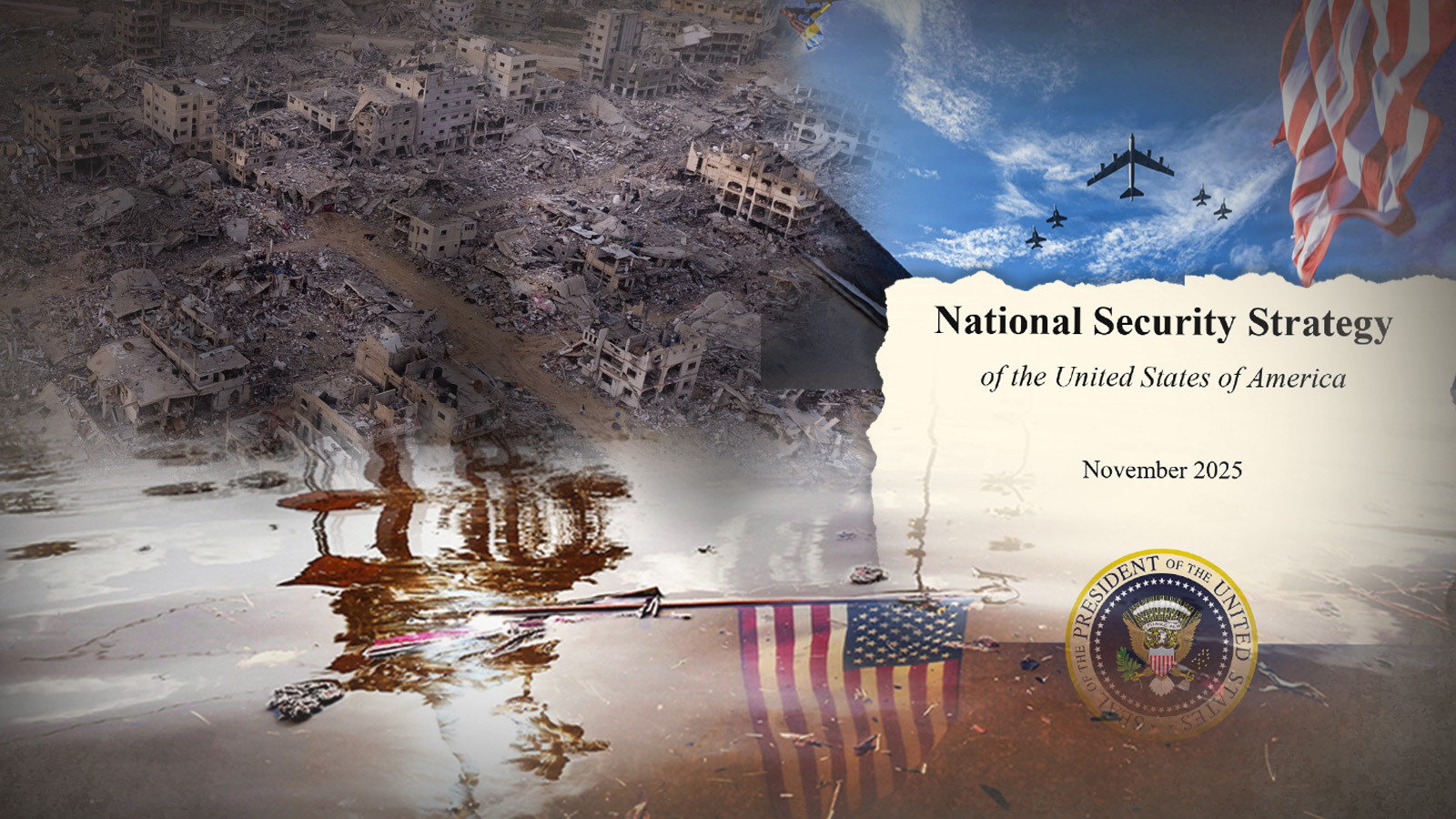
The National Security Strategy of the USA, released last week, signals an intensification of competition and an escalation of wars across the globe, further fuelling the conflict with China for supremacy in the international imperialist system.
As the document states, “We want to recruit, train, equip, and field the world’s most powerful, lethal, and technologically advanced military to protect our interests,” as well as “We want to halt and reverse the ongoing damage that foreign actors inflict on the American economy.”
Its objectives include maintaining or achieving global supremacy in nuclear weapons, the economy, the industrial base, the energy sector, science, technology, and an “unrivalled soft power” that promotes US interests worldwide.
The Indo-Pacific region remains a priority, with a focus on the South China Sea and the area around Taiwan. The goal is to preserve “military superiority” over China and “freedom of navigation in all crucial sea lanes, and maintaining secure and reliable supply chains and access to critical materials.”
The text acknowledges China’s rise as a threat to US global supremacy: “What began as a relationship between a mature, wealthy economy and one of the world’s poorest countries has transformed into one near-peers.”
Indeed, as China continues to rapidly arm itself, the National Strategy stresses that “the American military cannot, and should not have to, do this alone,” emphasizing that US allies in the region must assume an enhanced role.
This message is directed at states that maintain economic or other ties with China (and Russia), urging them to break away from the Eurasian camp under formation and take a more active part in defending US interests in the region.
Regarding Russia, the document states that the US must “reestablish strategic stability” with it, which heightens turmoil within the Euro-Atlantic camp —particularly in relation to the evolving imperialist conflict in Ukraine. Although contradictory, the Trump administration’s strategy aims to undermine the strategic relationship between Russia and China.
Europe “remains strategically and culturally vital” to the USA, but “it is far from obvious whether certain European countries will have economies and militaries strong enough to remain reliable allies.” With the new strategy, the US increases pressure on its European allies to shoulder more of their own “defence” burden and, in this context, to accept a compromise with Russia.
In the Middle East, US vital interests coincide with preventing "an adversarial power from dominating the Middle East, its oil and gas supplies and the chokepoints through which they pass.”
The National Strategy also makes special reference to the American continent, envisioning a Western Hemisphere where the US retains absolute dominance, “free from hostile foreign incursion or ownership of key assets (...) [and ensuring] our continued access to key strategic locations.” This amounts to a direct threat to countries in Latin America and the Caribbean that maintain relations with China.
It is worth noting that the Community of Latin American and Caribbean States (CELAC), which brings together 33 countries, has close ties with China. For countries such as Brazil, Peru, and Chile, China is the leading trading partner, surpassing the USA.
This largely explains the USA’ escalating aggression against countries in the region, most recently Venezuela.
The updated National Security Strategy of the USA continues in line of all previous strategies while also acting as a catalyst for imperialist rivalries, which pose new dangers for the peoples but at the same time highlight the necessity of the struggle to overthrow capitalism that is in decay.
As noted in the Theses of the Central Committee of the KKE for the 22nd Congress: “The USA, which still holds the leading position, is trying to halt the shift in the balance of power in China’s favour. (...) US policies are sharpening contradictions within the Euro-Atlantic camp and causing a deterioration in relations between the USA and the EU, Canada and Australia. They are exacerbating intra-bourgeois contradictions within the USA, which are also reflected in developments within the bourgeois political system. (...) The sharpening of inter-imperialist contradictions could widen existing cracks in the Euro-Atlantic axis in the coming years. (...) In this context, bourgeois states are casting aside diplomatic channels, giving priority instead to trade and economic wars, as well as military preparation."
The article was published in the "Our Opinion" column in Rizospastis, the organ of the Central Committee of the Communist Party of Greece, on 12/12/2025.