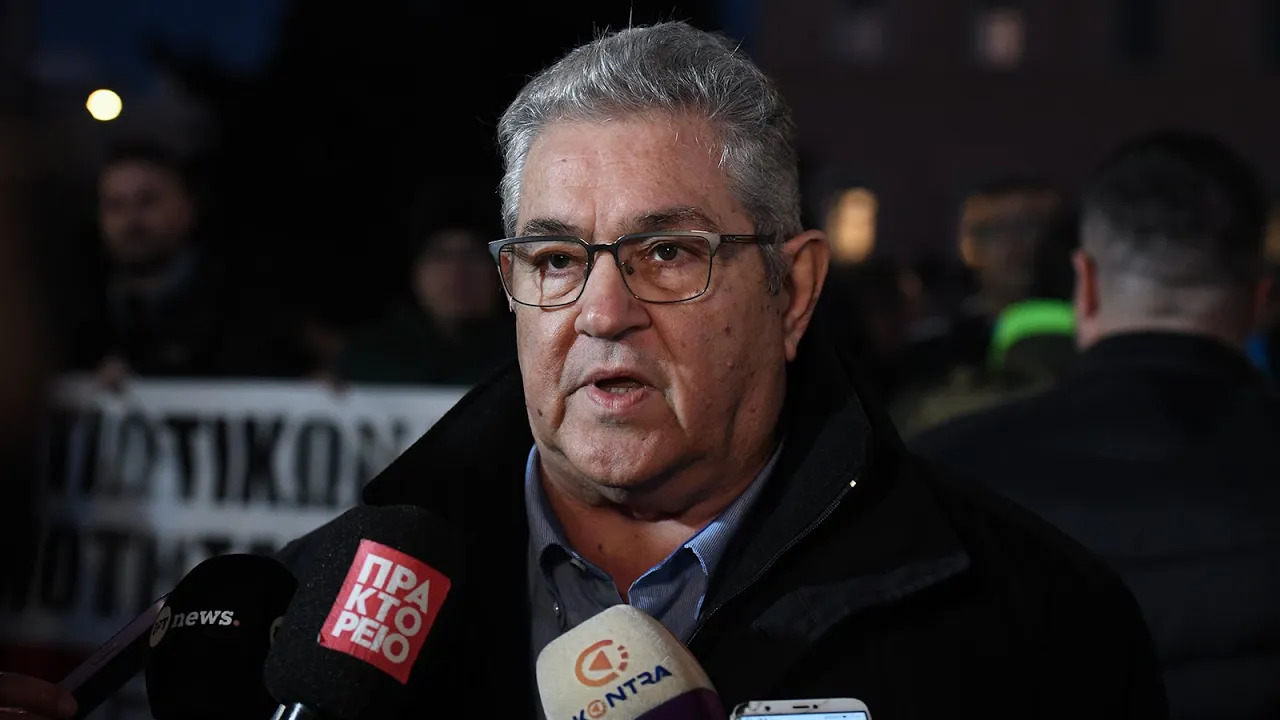
On 21 December 2025, an interview with by Dimitris Koutsoumbas, GS of the CC of the KKE, conducted by journalist Panos Haritos, was published on the website Nonpapers. Below is the second part of the interview, which focuses on Greek foreign policy, such as Greek–Turkish relations, as well as current international issues, including the imperialist war in Ukraine and the negotiations for its settlement, the Palestinian question, and developments in Latin America.
Mr. Koutsoumbas, does the peace agreement model proposed by the US president for Ukraine raise concerns about Greek–Turkish relations and the Cyprus issue?
It is certainly worrying, but it did not emerge out of the blue. At least we are not caught off guard. It was preceded by the invasion and occupation of Cyprus by our “ally”, Turkey; the secession of Kosovo with NATO bombings; the dismantling of Libya, also with NATO intervention; Afghanistan; Syria; and many others, which demonstrate that the leaders of “revisionism” of international law are the USA, NATO, the EU, and that their work in dismantling international law is mirrored by the leadership of capitalist Russia. It is as if it copied the playbook, even in the arguments it used, adding a touch of anti-fascist twist.
The Prime Minister claims that the government’s priority is the continuous strengthening of the Armed Forces, emphasizing that the country can spend more than 3% of GDP on defence and return a share of growth to citizens while achieving surpluses. Two questions arise: Is this really feasible based on the economic data? Does the current way the armed forces are equipped meet the country’s actual needs?
We cannot be naive. The facts show that the government spends billions of euros, not on defence and national security, but on the needs of the bourgeois class, e.g. shipowners, who want a war fleet to protect their interests, along with those of their allies: NATO, the EU, and the USA. This is how the Greek “Patriot” artillery ended up in Saudi Arabia, while tens of millions are wasted annually on fuel for Greek fighter patrols over the Balkans, supposedly to protect neighbouring countries from Russia. This occurs at a time when the government claims it has no money for health, education, pensions, or salaries. This class-based policy is the elephant in the room, extending to the new frigates, which are also intended for the Euro-Atlantic bloc’s confrontation with its competitors in the South China Sea.
According to the new US ambassador and the government, Greece is becoming an energy hub with the Revythousa gas pipeline. How important is this pipeline —both today and in the long term? What are the benefits for our country —do we gain anything regarding national interests?
Clearly, the pipeline is important, but for specific interests. In a society deeply divided into classes, such as the Greek one, any economic benefits will be directed to the few large monopoly interests that will reap the rewards. The rest will have to settle for promises, lofty speeches, national visions, and other rhetoric lifted straight from nationalist propaganda. As for national issues, the government is deliberately fostering a false image that it has managed to become Mr. Trump’s “favourite”, and that this will supposedly benefit national interests. The landing will be rough. In fact, I would argue that this development is putting us on a dangerous path.
Have you been following the issue that has arisen with Cosco and the port of Piraeus? Can such issues be raised following agreements, and can we get involved in the USA–China conflict? Do we gain anything from this? Is there any logic in the idea of upgrading the port of Elefsina?
Well, not only the government, but also other parties support the idea of turning the country into an energy and transit hub, aiming to increase the profitability of large Greek monopolies, to “grow the pie” of the economy, while hoping that a few crumbs will fall to the rest of the population. This plan always aligns with the plans of the EU, the USA, Israel, China, etc., which are in competition with each other. I said before that we are entering dangerous territory. In fact, our country and our people are caught in the millstones of competition among major powers such as the USA, China, the EU, and Russia.
But let me add another perspective. Before the war, Ukraine was an energy hub, with tens of thousands of kilometres of natural gas and oil pipelines, and 20–25% of Black Sea trade passed through the port of Odessa. Today, its people are shedding their blood! Because being a hub means profits for the few and bloodshed for the many. Of course, their allies, the Europeans and the Americans, did not save them, even though they are presented here as a “guarantee” of security and peace.
Is Trump’s proposal for peace in Ukraine good or tailored to Moscow’s needs?
The Trump administration is looking to pave the way for the profitability of US monopolies, which will participate in the reconstruction of Ukraine and the exploitation of its mineral wealth. Through political and economic cooperation with Russia, it will also attempt to draw it in or neutralize it in the great confrontation with China. That is their goal, and of course any agreement will be temporary, because it will not resolve the real causes of this imperialist conflict, but will simply sweep them under the rug.
Is anyone benefiting from the war in Ukraine?
What is certain is that two peoples who lived and prospered together during the years of socialism are being slaughtered. Of course, the monopolies of the war economy; the bourgeois classes, fostering hatred to consolidate their power and the exploitation of the people; the energy monopolies of “green” growth; and various middlemen taking advantage of the sanctions, are the ones benefiting.
How realistic are the Europeans’ positions on Trump’s plan?
The dominant circles of the EU believe that Trump’s plans do not take their own interests into account, which is why they are reacting. But the Europeans are not united either. Some monopolies and major interests in the EU lose out in the war, while others gain and grow stronger. That is why we are witnessing serious political processes within EU countries. It is clear that their internal fights are intensifying.
Should Moscow pay for the reconstruction of Ukraine?
What is called reconstruction is a big “feast” for construction companies, carried out at the expense of the peoples of Ukraine and Russia. It will be the basis for their further exploitation, mortgaging the future of many generations to come. Reconstruction also has an anti-popular, pro-monopoly, and capitalist character.
Can Europe, without the USA, escape the model of guaranteed and cheap security from NATO by arming itself and creating a modern army? Is there a need for this? Is it really threatened by Russia?
Let us bear in mind that what is called Europe, i.e. the EU, accounts for only 42% of European territory, while 58% belongs to European states that are not members of the EU. The EU itself is a reactionary creation, designed to serve the interests of European monopolies. The peoples of Europe have only suffered from this EU. Now, this reactionary creation is seeking to acquire military “muscle” in order to respond to the conditions of competition with its rivals, which are not only Russia, but also the USA, China, and others, with which it both cooperates and competes.
Is the war economy a response to, or a problem for, the stagnation of European economies? Who benefits from this economic model?
The war economy has multiple implications. Apart from the flow of resources — which, instead of being allocated to social needs, are directed to war industries and others— and in addition to the EU’s desire to participate more actively militarily in competitions with other powers in Africa, the Middle East, and elsewhere, shedding the blood of peoples, it is also exploited by the ruling circles to silence the peoples in their social protests and struggles. In other words, they are saying: do not speak out now, do not make demands, because we are preparing for war. All of this results from the further reactionary stance of the imperialist EU and has nothing to do with the needs of its peoples.
Is the 20-point agreement for peace in Gaza a glimmer of hope for an end to the war and a resolution of the differences between Israel and Palestine?
The slaughter continues, the occupying troops remain in Gaza, and the plan to turn it into a US–Israeli protectorate is underway. I will put it very simply: nothing can be resolved without the liberation of the Palestinian people; without the establishment of their state, within the pre-1967 borders, with East Jerusalem as its capital; without occupying forces, settlements, and settlers; without the release of tens of thousands of political prisoners and the return of refugees.
Why did Europeans applaud this agreement despite the fact that it had no timetable and no clear description of the stages of implementation or of those involved, while in the case of Ukraine and a similar agreement they spoke of the need for a fair agreement? Is the agreement fair for the Palestinians?
Because the EU, the US, and Israel believe that this agreement can weaken the liberation struggle of the Palestinian people and make the two-state solution more difficult, if not impossible. Clearly, it is an unfair agreement, like so many others that have been devised and implemented by the imperialist powers.
Should Israel be held accountable for what was done in Gaza? Should it pay for its reconstruction?
Clearly, the crimes committed by Israel in Gaza must not be forgotten. Netanyahu and the other responsible parties must be held accountable. The main issue, however, is not strictly economic, limited to clearing the rubble and rebuilding what Israel’s war machine destroyed, or even to recovering the bodies of tens of thousands of innocent people. It is political. It has to do with the occupation, the genocide of the Palestinian people, and the apartheid imposed on them by Israel, with the backing of the so-called “international community” and despite the outcry of millions of people around the world.
Was the Hamas attack on 7 October an act of terrorism?
The concept of terrorism has become an elastic concept these days, exploited by the USA, the EU, Russia, Turkey, and all bourgeois states, to one degree or another, in an ambiguous manner, as it suits each one. You know that the KKE is diametrically opposed to the ideological, philosophical, and political approaches and practices of this particular organization, but we will not do anyone the favour of characterizing the struggle of a people who have been under occupation for seven decades as terrorism. Moreover, we give no credence to the evidence fabricated by the Israeli authorities regarding the “atrocities of Hamas”, as much of this fake news was debunked within the first 24 hours, including through presentations of evidence by Greek journalists at public events. We have said this many times. The real terrorists are the occupiers, the murderous state of Israel, and the Palestinian people, like any people, have the right to organize their struggle using the means they deem appropriate.
Will the Palestinian question be resolved one day, or do Israel’s current actions sound the death knell of any possibility of a two-state solution?
There is no way that the Palestinian people, who have earned the respect of all humanity, will fail to secure their own homeland. They will achieve it through a very hard struggle and the solidarity of the peoples of the world, including the Greek people. No matter how many obstacles are placed in their path, no matter how many “death knells” are proclaimed.
What is the real problem in the region?
The war in the Middle East, spearheaded by the brutality of the Israeli occupying state against the Palestinian people, is related to the Israeli bourgeoisie’s aspiration to impose a plan that will make Israel the dominant power in the entire Eastern Mediterranean and Middle East region. This is pursued either through the carrot of economic agreements, such as the Abraham Accords, or through the stick of military aggression, invasion, and occupation of foreign territories, as well as the military weakening of other competitive bourgeois regimes in the region, such as Iran. This enhancement of Israel’s role —among other things as a transit hub between Asia and Europe, taking advantage of the coastal “prime real estate”of the Gaza Strip and the exploitation of hydrocarbons in the Mediterranean— is being exploited by the USA and the EU for their own purposes.
How can we interpret the acceptance of the current Syrian president, Ahmed al-Sharaa, by the international community and organizations, given that his past is not exactly synonymous with international law and respect for human rights? Has the civil war in Syria come to an end?
This is where their hypocrisy regarding terrorism becomes apparent. The terrorists were whitewashed by the Euro-Atlantic imperialists and presented as angels, since this perfectly aligned with their plan to reduce Russian influence in the Middle East. We are talking about an anti-popular regime that emerged with the backing of Turkey and has already shown negative signs in its first year of existence. Nothing is over yet; everything remains on the shifting sands of competition between bourgeois classes and imperialist powers in Syria and the wider region, where ethnic and religious differences, as well as major social contradictions, could give rise to new developments.
Has the Chávez socialist model failed, or are the alternative proposals powerless against the mechanisms of control of the global economy?
The essence lies in the fact that capitalism, like any socio-economic system, has ironclad laws. Even if you rename capitalism “21st-century socialism” and give a few crumbs more to some sections of the workers, you cannot escape its relentless and exploitative nature. Chávez, and even more obviously Maduro after him, may have spoken grand words about “revolution” and “socialism”, but since the time of Marx and Lenin, it has been known that revolution requires profound socio-political changes, which never took place in Venezuela. You cannot make an omelette without breaking eggs. Furthermore, since the country and its economy operate on a profit basis, since labour power continues to be a commodity, and since the country is deeply integrated into the global capitalist economy and trapped in a vise of fierce competition among the strongest players, nothing will change no matter how often the word “anti-imperialism” is invoked.
Why is Trump threatening Caracas and why is he targeting Petro in Colombia? What is at stake?
A look at the recent US National Security Strategy gives us the answer, which lies in the so-called “restoration” of American pre-eminence in the Western Hemisphere. Who has shaken this pre-eminence? Evidence shows that China is rapidly strengthening its commercial footprint, especially in South America. It is now South America’s leading trading partner and second only to the US across Central America, South America, and the Caribbean. Thus, the US Security Strategy also signals a transition for the American continent to an even more dangerous phase of competition for supremacy in the international imperialist system. As for Petro, the social-democrat president, I would say that he has received the message, judging by his latest statements recommending a “transitional democratic government” in Venezuela, so that the crisis does not spread to his own country, as he says.