Rightfully, Fidel Castro belongs in the pantheon of historical memory and the consciousness of peoples around the world. It was he and his comrades who conceived the idea of the Cuban Revolution. As he himself notes, “If we had not studied Marxism, if we had not been inspired by Martí, Marx and Lenin, we would not even have conceived the idea of a revolution in Cuba”.
As the imperialist force that found itself at the top of the pyramid after the Second World War, the USA began to undermine the Cuban Revolution from the moment it was victorious.
With the proclamation of the socialist character of the Revolution in 1961, the Democratic Party government under Kennedy ordered the imposition of a harsh embargo on Cuba. This turned into a complete blockade when the Revolutionary Government nationalised and placed under workers’ control large industrial facilities belonging to US monopolies, thereby strengthening the foundations for the construction of socialism in Cuba.
From the very first months following the overthrow of the Batista regime, Fidel realised that victory and the defence of the Revolution required a massive popular mobilisation. He was aware that the period of socialist construction is a period of intensified class struggle, in which the oligarchy of wealth—having lost everything, including the basic means of production—and its international allies do not give up their efforts to overthrow the revolution.
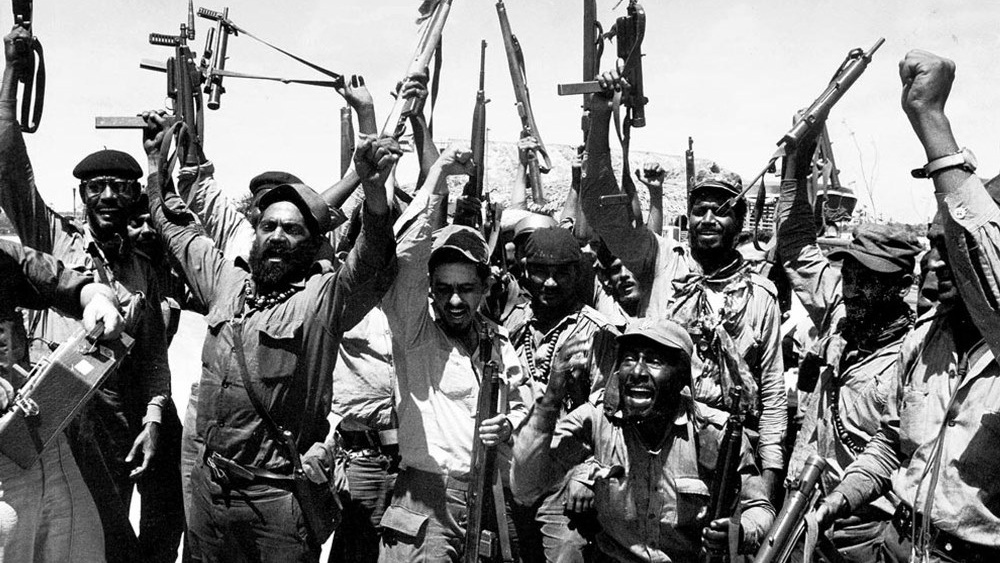
In 1960, Fidel announced the formation of the Committees for the Defence of the Revolution, a collective revolutionary system of vigilance in every neighbourhood, with the direct involvement of the entire population, under the guidance of the Communist Party. These were the civil defence battalions, with the slogan “one man for every weapon” so that, as he noted, “our combat units would be perfectly organised and trained” as soon as possible.
The immense revolutionary strength of the Cuban people was quickly put to the test when North American imperialism organised an invasion by US-trained mercenaries in the Bay of Pigs. The aim was to overthrow the young Cuban Revolution, but the people repelled the attack. Armed and led by the Communist Party, the Cuban people repelled the enemy's superior forces! This victory has great historical and enduring significance. It proves that the most technologically advanced armies of bourgeois states cannot overcome a people in revolt who are fighting for their rights, defending their homeland, and protecting their achievements.
The USA systematically sought to isolate Cuba and prevent it from developing relations with other countries. However, with the support of the USSR and other socialist countries, Cuba was able to overcome problems that still plague capitalism, such as unemployment, illiteracy and preventable diseases. This laid the foundations for the development of science, the arts, culture and mass popular sport institutions. Universal people’s rights were established, including free healthcare, education and housing, which are now vanishing even in developed capitalist countries.
Cuba reciprocated this solidarity with the peoples fighting for their independence, against capitalist exploitation, racism and imperialism. Fidel, closing the 1st Congress of the Communist Party of Cuba, declared: “We are part of the global revolutionary movement”.
Cuba, with its 500,000 fighters on internationalist missions, put proletarian internationalism into practice, realising that the best defence for itself lay in supporting national liberation and revolutionary movements in other countries and in drawing countries away from the capitalist camp.
Following the overthrow of socialism in the USSR, Fidel, with great foresight, realised that an unprecedented ideological assault by the supporters and apologists of capitalism was imminent. In response, he launched the 'Battle of Ideas', recognising that the ideological-theoretical element of the class struggle must be elevated and that ideological-political confrontation would require significant effort, particularly among younger generations who had come of age after the counter-revolution.
This remains valid today. Ordinary people throughout the capitalist world are experiencing the intensity of imperialist rivalries and wars, a looming new capitalist crisis, deepening poverty, unemployment and displacement. All these are the results of the normal functioning of the capitalist system.
For the revolutionary communist ideology to gain ground, it is essential at every stage and in every period to reaffirm the Communist Party's role as the ideological, political and organisational vanguard of the working class. This is crucial in order to fulfil its historic mission of overthrowing capitalism and building socialism and communism.
Once again, it is confirmed that mass workers' and popular struggles for contemporary rights must be infused with communist ideology so that a way forward can be found. The possibilities of our era must be viewed from the perspective of the working class. It is crucial to recognise that the obstacles to meeting the ever-growing demands of workers are capitalist ownership of the means of production and production for profit.
The very history of the Cuban Revolution and its achievements, moreover, proves that the elimination of profit as the criterion of production, and the building of socialist relations, can change the course of any country and serve the interests and needs of the working people.