Skip to content

ON THE BOURGEOISIE’S DEEPEST DESIRES - Will the Cuban revolution die?

Date:
Jul 10, 2026
sygkentrosi-cuba-poreia-7

An article posing this question was published in late June and later reprinted by several Greek bourgeois media outlets. The author frames the issue as follows: “Under the threat of a US invasion, are these the final days of ‘socialism’ in Cuba, or can Havana’s recent reforms preserve anything?”

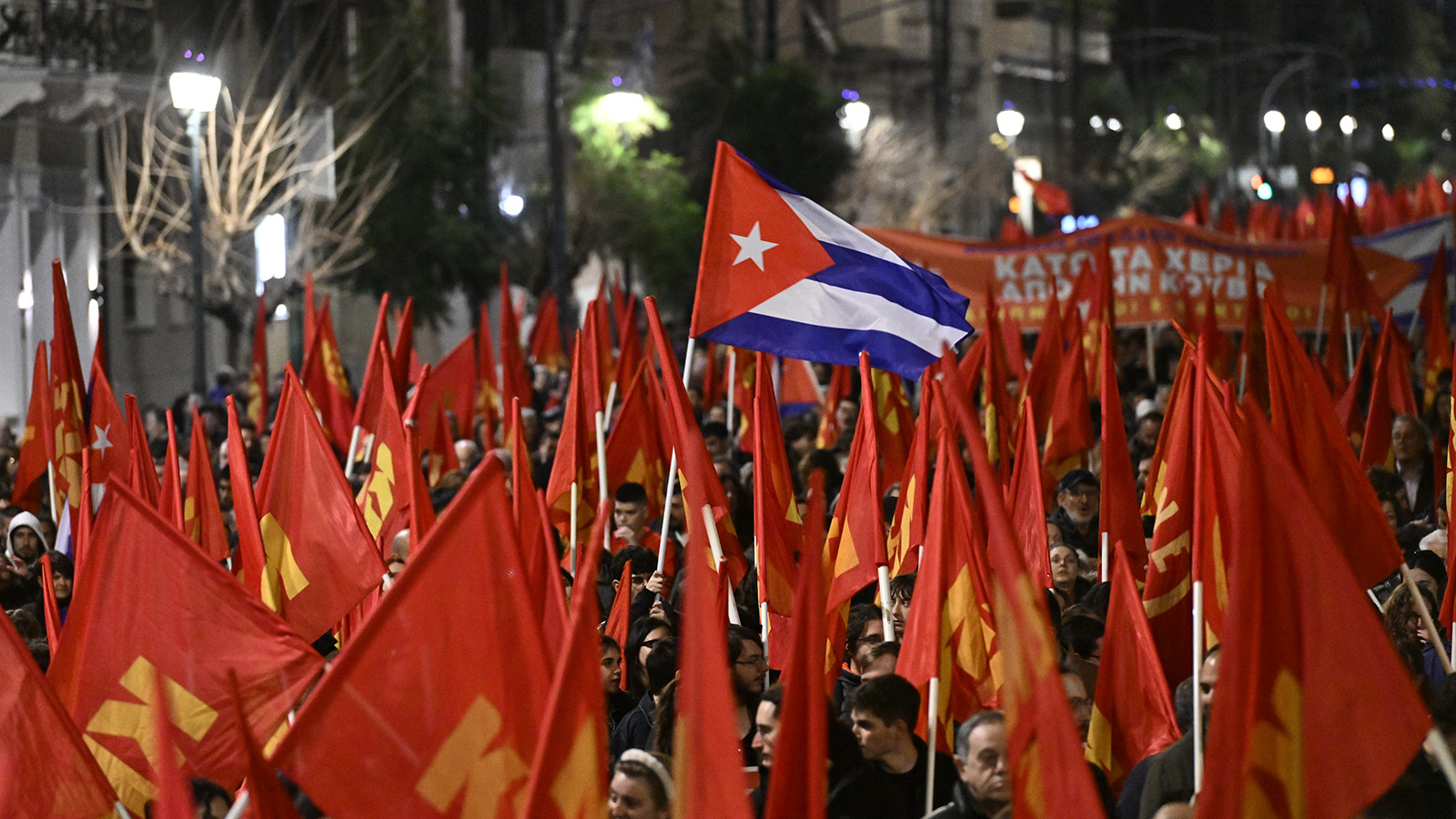
Although the article does not provide a clear answer to the question posed in its title, it is clearly aimed at those who follow developments on the Island of the Revolution, particularly the many thousands of workers and young people who, over the years, have consistently expressed —and will continue to express— their solidarity, just as they do with every people subjected to imperialist aggression by the US and the EU, especially when that people is the heroic people of Cuba.

We are well aware that this imperialist aggression did not arise without cause. It was provoked by the conscious and militant decision of the Cuban people to overthrow a dictatorial bourgeois regime through revolutionary means —through their armed struggle—and to strive to build a new socialist society free from the exploitation of man by man. This first socialist revolution in the Americas provoked the “holy” indignation of exploiters of every kind throughout the world and their mouthpieces.

For many years, the Cuban people defended this choice, at times even with arms in hand. It is, of course, well known that they embarked on this path with the support of the Soviet Union and the other socialist states in Europe, securing significant achievements that made Cuba a model for peoples —particularly those of Latin America and the Caribbean, where the productive forces were at a comparable level of development— of what can be achieved when a people overthrows capitalist barbarity.

These achievements included:

  • Universal and free access to healthcare through the establishment of an extensive and pioneering public health system.
  • The eradication of illiteracy through the major literacy campaign of 1961, at a time when functional illiteracy remains widespread across Latin America.
  • The establishment of free, public education at every level.
  • High life expectancy and low infant mortality compared with many countries in the region.
  • The provision of international medical assistance through the deployment of thousands of doctors to countries in Africa, Latin America, and Asia.
  • A commitment to social equality and the elimination of social and racial inequalities, while such inequalities continue to grow dramatically in the neighbouring United States.
  • The implementation of agrarian reform through the redistribution of large landed estates into state or cooperative ownership.
  • The anti-imperialist stance, including the dispatch of even armed volunteer units to Africa, which played a decisive role in the struggles of the peoples of Angola and Namibia for independence and in the fight against apartheid in South Africa.
  • Inspiring numerous movements throughout Latin America and beyond through its defiant stance against US machinations, interventions, and military supremacy.
  • The promotion of mass participation in popular sports and culture, achieving notable successes in international competitions while ensuring broad public access to the arts, in contrast to the capitalist world, where these fundamental needs are commodified.

Dangers posed by economic reforms

As an integral part of its internationalist duty to express unwavering solidarity with Cuba and its people, the KKE has, over many years, consistently and responsibly studied both the hostile international environment in which the Cuban people are waging their struggle and developments on the Island of the Revolution. For this reason, it has never concealed the fact that Cuba faced immense difficulties following the overthrow of socialism in the USSR and Eastern Europe.

The erroneous position adopted by the International Communist Movement regarding the irreversible course of socialist construction left Cuba unprepared, with key sectors of its economy underdeveloped and insufficient attention paid to achieving self-sufficiency in essential goods. Consequently, the dissolution of the Council for Mutual Economic Assistance (CMEA), together with the end of trade within its framework, dramatically intensified the problems caused by the criminal US blockade.

This also led to the weakening and eventual abandonment, in 1992, of the “Process of Rectification of Errors and Negative Tendencies”, adopted by the Communist Party of Cuba in 1986 to reverse a number of market-oriented measures introduced during the preceding years.

Subsequently, the Communist Party of Cuba made significant retreats, reflected in the decisions of its 6th Congress in 2011. Among other consequences, these decisions permitted the emergence of entrepreneurs employing and exploiting the labour power of up to one hundred workers.

A private business sector emerged, initially justified as a necessary concession. During the same period, the EU, competing with the US, pursued a strategy of economic penetration into Cuba by European business groups through the so-called EU–Cuba Political Dialogue and Cooperation Agreement (PDCA). At the same time, it instrumentalized its campaign in support of counter-revolutionary forces within Cuba by hypocritically invoking alleged human rights violations.

Today, following decisions adopted by the Communist Party of Cuba and approved by the country’s National Assembly, further measures are being promoted to strengthen commodity–money relations. These include allowing state-owned companies to become joint-stock companies; permitting capitalists to employ more than one hundred workers; abolishing the state monopoly on foreign trade; opening key sectors and areas of the Cuban economy to foreign capital, banks and large-scale investments by capitalist enterprises; and granting land for business activities.

However much they are presented as strengthening socialism, these measures move in precisely the opposite direction. They weaken social ownership of the means of production and central planning, which constitute the scientific laws of socialist construction, and pose enormous risks to the people and their achievements.

Historical experience provides a clear warning: in the USSR, too, perestroika was not initially intended to restore capitalism, as it ultimately did, but rather to achieve “more democracy, more socialism!”. Even more problematic are attempts to justify the reforms in Cuba by referring to China, where capitalist relations of production have long since prevailed and which now competes with the US for supremacy within the international capitalist world, defending the profits of Chinese billionaires —many of them members of the Communist Party of China— against their American, European, Russian, and other rivals.

Nor, of course, are comparisons with Lenin’s New Economic Policy (NEP) valid. The NEP represented a planned, conscious and, above all, temporary retreat by the world’s first workers’ state, a retreat that was overcome within only a few years after which the Soviet power proceeded decisively to consolidate and strengthen socialist relations of production. Moreover, the capitalists of the NEP period in revolutionary Russia —the so-called Nepmen— not only were excluded from the Communist Party, i.e. the Bolshevik Party, but were also deprived of all political rights.

Immediately after the overthrow of socialism in the USSR, the KKE undertook an in-depth study of the process through which socialism was overthrown, focusing on economic reforms, measures taken within the political superstructure and the strategy of the communist movement. Among other things, it highlighted the internal struggle within the CPSU, the growing dominance of market-oriented approaches and, ultimately, the role played by the expansion of commodity–money relations and the market, together with the erosion of social ownership of the means of production, central scientific planning, and workers’ control —all of which constitute fundamental scientific laws of socialist society.

Revolutions cannot be erased!

The achievements of the Cuban Revolution are indeed under threat. But does this mean that the Cuban Revolution will die, and that its invaluable legacy and lessons will disappear?

However much some may believe they can rewrite history, they will not succeed!

The dead ends of the capitalist mode of production are such that socialism remains the only realistic alternative for the peoples, even if the outcomes of the wave of socialist revolutions during the 20th century have, for the time being, been reversed.

For in the 21st century, too, the peoples will continue to be inspired by the radiance of the social achievements that can be attained in a world without exploiters, as demonstrated by the USSR, Cuba, and other socialist countries, despite whatever weaknesses and mistakes may have occurred.

We will continue to draw inspiration from Che’s words: “For us, there is no valid definition of socialism other than the abolition of the exploitation of man by man”. Fidel’s call —“Socialism or Death”— will continue to accompany us.

The 21st century will inevitably be a century of new and victorious socialist revolutions.