The International Communist Movement is facing a chronic and profound ideological, political, and organizational crisis. A significant number of Communist Parties that resisted ideological mutation and remained steadfast during the counter-revolution and faithful to Marxism-Leninism and proletarian internationalism, have been unable to draw conclusions regarding the programmatic causes of the counter-revolutionary overthrows, to study both their history and the history of the communist movement, or to formulate their strategy accordingly — a strategy that reflects the contemporary needs of the class struggle, the struggle for socialist revolution, the overthrow of capitalism, and the construction of socialism–communism.
- They fail to interpret the character of our era —an era of transition from capitalism to socialism— and the character of the revolution as socialist in an objective manner. They remain stuck in the strategy of intermediate transitional stages within the framework of capitalism, resulting in a focus solely on the struggle against neoliberalism rather than against the exploitative system as a whole. Furthermore, they are trapped in the pursuit of reforms, such as nationalizations within the framework of capitalism and in chasing the chimera of “anti-imperialist”, “anti-monopoly”, “national liberation”, or other stages toward socialism.
- They do not see view democracy as an enemy of the working class and the peoples, nor as a pillar of capitalism, but rather as a kindred political force. They move toward unity among “leftist and progressive forces”, promoting the “structuring” of the communist movement alongside social democratic forces and attempting to co-opt the Communist Party into such alliances. They pursue a line against neo-colonialism and fascism, in a manner detached from capitalism, the very system that gives rise to them. They praise the so-called “progressive” governments, for example in Latin America, which have served and continue to serve the interests of capital.
- They defend the concept of “national paths” to socialism and the so-called “21st-century socialism” or “market socialism”, which, although presented as a “mixed economy” intermediate between capitalism and socialism, is in reality a form of capitalist management where the expanded intervention of the capitalist state in the economy serves primarily to safeguard the interests of capitalist ownership. These are adaptations of capitalism under conditions of deep crisis, war, etc., familiar throughout the 20th century, and have nothing to do with the principles and scientific laws of the socialist revolution, nor do they lead to socialist construction.
- They present the role of the UN and “international law” in a positive light, overlooking the fact that the shift in the international correlation of forces resulting from the overthrows has a negative impact on the role of international organizations established after the end of the Second World War. As a result, these institutions are now aligned with the strategic objectives of the USA and NATO rather than serving the interests of the peoples.
The imperialist war in Ukraine has caused new ideological and political divisions and deepened existing ones. Communist parties, which previously identified imperialism solely with the aggressive foreign policy of the USA and certain powerful capitalist states in Europe and glossed over the role of other capitalist states, now see Russia, China and Iran as supposed “anti-imperialist forces” or even an imaginary “anti-imperialist axis”.
Such forces, in an unscientific manner, overlook inter-imperialist contradictions and competition, which are the root cause of imperialist wars, and believe that a “just”, “peaceful”, and “multipolar world” is taking shape. Some of them support China, Russia, or the European Union, viewing these forces as “formidable adversaries” of the USA, and equate the aspirations of the bourgeoisie in these states or unions with the interests of the working class and the popular strata of their countries. They elevate individual necessary compromises and manoeuvres into ideological principles, giving them the appearance of a programmatic stance. The unfavourable international correlation of forces certainly has an impact, as does the idea of seeking support in the context of the negative international correlation of forces. Meanwhile, the correct Leninist position on exploiting inter-imperialist contradictions for the benefit of the revolutionary workers' movement and socialist power is distorted.
This negative situation has had a catalytic effect on the International Meetings of Communist and Workers’ Parties (IMCWP), which were initiated by the KKE but have gradually lost momentum, along with the original reasons for their creation and their initial significance. They have increasingly become a space of intense, fruitless confrontations, recycling the crisis of the communist movement. At the same time, serious and unresolved operational problems remain, mainly of an ideological and political nature, especially following the outbreak of the imperialist war in Ukraine.
The ideological struggle is not limited to parties that have undergone ideological mutation or continued the tradition of Eurocommunism, nor to those that still adhere to the bankrupt strategy of transitional stages, the erroneous policy of detaching imperialism from the monopolies, i.e. its economic base, or the failed line of cooperation with social democracy, the parliamentary road, and similar approaches. Today, the struggle has taken on greater proportions and involves parties with which the KKE previously maintained relatively good relations, despite ideological and political differences. These parties have abandoned fundamental communist principles, supported the Russian bourgeoisie in the imperialist war, aligned themselves with the Eurasian camp, became supporters of Chinese capitalism, and questioned the laws of socialist construction. Such forces are now rallying around the “International Anti-fascist Forum” or the so-called “World Anti-Imperialist Platform” which, among other things, is also carrying out an anti-KKE mission.
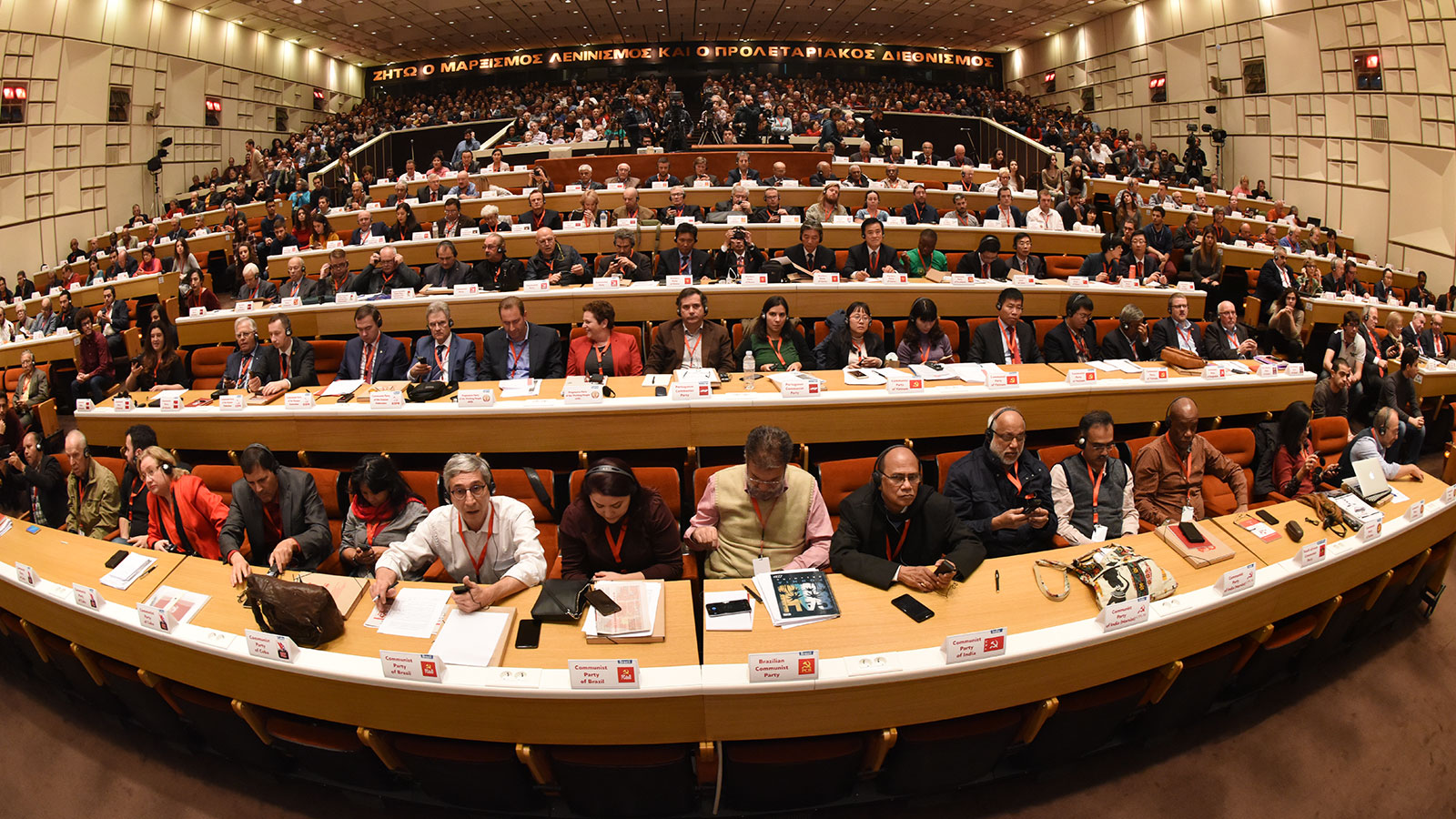
This situation has arisen at a time when developments have underscored the need for a revolutionary regroupment of the communist movement, defended by the KKE and by the Communist Parties with which our Party cooperates within the framework of the European Communist Action (ECA) and the International Communist Review (ICR), as well as dozens of other Communist Parties from around the world, with whom we engage in comradely discussions. Some of these parties also participated in the recent internationalist event in Athens in November to commemorate the October Socialist Revolution.
The KKE, faithful to the principle of proletarian internationalism and mindful of the international character of the class struggle and the necessity for a unified strategy within the communist movement, struggles to form a Marxist-Leninist pole and to regroup the European and international communist movement in a revolutionary manner.
(This excerpt is from the Report of the Central Committee of the KKE to the 22nd Congress, which was unanimously approved by its delegates.)