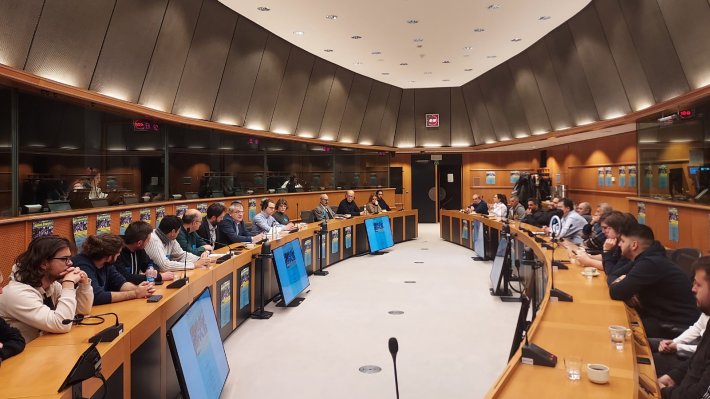
Dear comrades,
The issue of housing or, to put it more precisely, the issue of meeting the housing needs of the working class and popular families has always been a great front of struggle of the labour movement, of the communists who act within it.
The meeting of housing needs reflects comprehensively the connection with the contemporary needs and how they develop over time, based on the evolution of life and the possibilities to meet them, to provide real prosperity and progress for the lives of the workers.
The concept of housing needs includes not only the acquisition of a house, but also anything related to it that facilitates the life of the working class and popular family.
It is related to:
- The need for all family members to be able to have their own space in the house. The children should have their own room for studying, playing, resting, the parents should have theirs for resting, a separate room as home office, etc.
- The need for workers to be able to cover the costs related to the use of heating, electricity, connection to water supply, sewerage.
- Meeting the respective housing need that arises when the child of the family moves to a different city to study, away from their area of residence.
- Providing the possibility for a young person to acquire a house quickly and not being forced, due to economic conditions, to live with their family even at the age of 35 and 40.
- The connection of the transport network and smooth access to the workplace and back.
- The existence of the necessary infrastructure, nurseries, schools, primary health centres, sports facilities, for the needs of families.
- The construction of safe, quality housing and infrastructure, with earthquake protection, and an extensive system of flood and fire protection in the area where they are located.
- The possibility of maintenance, upgrading and modernization of housing.
For the bourgeois state and capital it is convenient to squeeze the needs, which constitute a coherent whole, thus facilitating the commercialization "by the piece" and entrepreneurial action.
Comrades,
In the early 2000s, interest in housing construction was high among the companies in the sector because it provided the desired profitability.
With the beginning of the capitalist crisis in 2009, there was a big drop, leaving thousands of houses unoccupied due to financial weakness, even though the workers had enormous needs.
The governments of the capital, attempting to hide the unmet housing needs, used the argument that owner-occupied housing in Greece had reached a very high level (85%). If we were to focus only on that fact, meaning who owns a house and who doesn't, then we would have to come to the conclusion that the bourgeois state was trying to achieve, that the problem was not acute.
We might say here that who owns the house is also relevant, since the actual owner is the bank, and even when you go through fire and water to pay the mortgage, you finally acquire ownership of the house when it has been depreciated after many years. But precisely because we assess the issue from the point of view of the contemporary popular needs, we highlighted it comprehensively, helping the working class organizations to form a framework of struggle and demands based on their needs and not on the interests of the capitalists.
Therefore, every bourgeois government policy prioritizes the issue of the number of people who own a house and their last priority is whether the house is protected against earthquakes, floods, and whether it meets the overall housing needs. It is easy to understand why.
The sale of residential housing to workers, through their over-indebtedness to banks and big construction companies, generates more profit and at the same time offers the prospect of the housing returning to the bankers, compared to the construction of necessary and complete infrastructures, flood protection projects, in which modern and safe housing will be included.
Every year in our country, the houses of the working-class, popular families are affected by floods, are ruined by earthquakes, properties and lives are lost. The bourgeois state, in an attempt to hide its responsibilities, speaks of unforeseeable events that cannot be tackled. On the other hand, when it feels the pressure from the struggle and demands of the workers, it pledges to take measures to limit the risks, without ever doing so. At the same time, it promotes the mandatory private insurance of newly built houses in order to invoke its complete exemption from any compensation and responsibility for disasters caused by earthquakes, floods or fires. In addition, it imposes on the working class, popular families the so-called "green standards" and heavy taxes so that they can obtain the so-called energy certificate, forcing even the few popular households included in various programmes, such as the “Home Energy Savings Programme”, to make large expenditures of their own, either to build or renovate their house from their own savings.
Comrades,
Housing in capitalism will be very expensive for the workers, because it is considered a commodity and not a social good that all workers should enjoy on the basis of their work.
As an expensive commodity it will be accessible to less and less people. More and more people will be at risk of foreclosure.
The bourgeois state and its governments have ensured that the interests of the banks are safeguarded, making it easier for them to snatch the houses of the people.
The previous government of SYRIZA, which falsely describes itself as left-wing, established the liberalization of auctions, without any protection of the main house. It legislated the criminalization of protesting and preventing an auction, which means that anyone who protests, prevents or cancels an auction through their struggle is automatically charged in court with the risk of imprisonment. The General Secretary of the Builders' Federation, who will be taking the floor, next, will be tried in court on 19 December for this reason.
What we witnessed in our country a few days ago shows the brutality of capitalism. Police forces together with representatives of the banks and the vultures who want to take over the houses of the people, bursting into the house of a low-income pensioner at 5 a.m., breaking down the door and throwing her out of the house. This crime was prevented only by the mobilization of the working people, and the unions. This is the way to defend our lives, as the slogan that emerged from the struggles says, "Only the people can save the people".
Over the years, the governments, under the pressure of the class struggle, but also the sharpening of the housing issue, have planned and implemented their policy by attempting to make certain interventions. All the measures they took continued to serve the strategy of the capital, which dictated the safeguarding and increase of its profitability. They did not change the ultimate law of capitalism, profit.
In capitalism, the ones who pay for housing and housing needs are the workers, and it is the businessmen and the bourgeois state that collect from the workers to finance their profits.
In this framework, they make it an individual affair and responsibility of each person to acquire housing, and pay the loan installments to the banks, regardless of whether the state and the employers cut wages and pensions. It is and individual affair when someone eventually loses their house. Ultimately, the fault lies with the workers who failed to acquire and maintain their house, and not with those who smash their needs to make a profit.
Comrades,
In Greece, the main form of implementation of housing policy was expressed through the Workers’ Housing Organization (OKE), which was created in the 1950s. Until its abolition in 2012, it directly granted loans to beneficiaries under certain conditions either from its own funds or through loans with partial interest rate subsidies through banks.
The sources of funding of the Workers’ Housing Organization and its housing policy were derived from the workers' contributions, the employers' contributions (from the retention of the surplus value of the workers' labour) and the financial support of the bourgeois state, which very soon failed to fulfill any of its financial obligations or other obligations (maintenance of housing during the period of loan repayment, repair of defects, etc.).
The beginning of the capitalist crisis, which was followed by a huge increase in unemployment, and anti-labour measures of cutting wages, pensions, benefits, confiscation of the reserves and property of the Workers’ Housing Organization and the social security funds for the payment of the memorandum commitments, resulted in the escalation of the housing problem. Thousands of workers could not repay their loans and lost their homes, the interest of business groups in construction and project development was reduced due to lack of profitability and thousands of vacant houses that could not be sold.
Today, the increase in construction activity combined with the aggravation of the housing issue and all the issues related to it (energy issue, high rents), the low income of workers (minimum wage at 2007 levels), the high prices, forced both the government of the New Democracy and the other bourgeois parties, SYRIZA - PASOK, to announce proposals that would allegedly alleviate the problem and relieve the workers.
What we have to highlight in their proposals, which reveals the class character of their policy, is that they use the same bourgeois management tools to mislead and manipulate the workers in the framework of the interests and demands of the capital.
- They do not damage the interests of the banks and the big house dealers. On the contrary, they guarantee them new customers – workers to drain the sweat of their labour, taking advantage of their need for housing.
- The granting of loans applies to a very small number of beneficiaries. The government speaks of 10,000 beneficiaries, who, in reality, are not more than 2,000, including their family members, who are labeled 10,000 beneficiaries for the government's needs.
- The assets of the Workers’ Housing Organization, which was abolished in 2012 and was acquired with the contributions of the workers, are given for exploitation to real estate companies and entrepreneurs in exchange for the creation of some houses that will be given to beneficiaries with limited conditions and without any protection in case of inability of repayment.
It attempts to present the management tools it uses as new ones that will bring a different result for the workers by addressing the specific problem. But it continues to sharpen.
It is telling that for the acquisition of housing, practices followed in other capitalist states are presented as new solutions, where the borrower, after a period of staying in a house owned by the bank, will be able to negotiate whether or not to proceed with its purchase. All these stunts don't solve the problem, but rather mask the aim of the capital, which is to keep the workers paying for the house they live in for the rest of their lives without owning one with the burden falling on their children afterwards.
For the KKE, housing is a necessity and a right of all workers. Considering it as a field of profitable investment for the capital results in such problems being sharpened.
Therefore, there are no neutral solutions that satisfy everyone. And on the issue of housing and housing needs, two opposing worlds are clashing. What is needed is to evict the policy that regards the right to housing as a commodity and instead of being renters we become owners of the wealth we produce and of our own lives. Only the working class, socialism, can solve this problem through social ownership and scientific central planning that can ensure that all contemporary needs, housing and other social goods and rights are met. And this is the criterion of all planning.
Through Central Planning, the country's development potentials are put at the service of the people and their needs, all that human activity has created in science, technology and culture, ensuring a higher level of life, mental development and culture. Unemployment and job insecurity are eliminated, leisure time is increased, so that, among other things, the working people are able to participate actively and exercise labour control, and the character of the workers' power is safeguarded.
With the total abolition of capitalist relations, the relation between capital and wage labour, the means of production in industry, energy - water supply, telecommunications, construction, repairs, public transport, wholesale - retail and import - export trade, the concentrated tourism - food infrastructure are socialized, along with the land.
The Central Planning integrates labour power, means of production, raw and other industrial materials and resources, into the organization of production, social and administrative services. It develops spatial planning on the basis of the results of research concerning the definition of new needs, the elaboration of regulations and standards as well as on the basis of a nationwide plan for the management of waste, for the comprehensive management of the water resources for their protection and utilisation according to the criterion of people's prosperity and the construction of cities that will be people-friendly. It further develops construction for meeting the needs for housing, for public infrastructure works, for supporting agricultural production, industry, social services. It ensures people's housing based on modern standards combined with the reshaping of the cities, infrastructure for quick and safe transportation, protection against floods, fires, earthquakes. It ensures sufficient green spaces combined with zones for sports, culture and entertainment.
This is the only way to meet the need for safe, quality and high standard housing for all.
It calls for a confrontation with capital's strategy for the right to popular housing and the organization of the struggle against this policy, to strengthen the demands for immediate measures, some of which are also put forward by the trade unions, which could give a great relief to this issue to thousands of families, and revive the building activity by demanding that the big capital pay, such as:
- Comprehensive housing planning by re-establishing the Workers’ Housing Organization and strengthening the exclusively state-owned construction programme. Utilization of the reserves of the former Workers’ Housing Organization and its large property for the needs of the workers and youth. Banning auctions of people's houses and measures against high prices. Substantial wage and pension increases, substantial protection of the unemployed.
- The demands of the student movement for a 300-euro monthly subsidy for all the students living on rent. A cap on rent prices. Under the responsibility of the state apartments and hotels to be used for free accommodation. Immediate rent subsidy for teachers who are posted away from home. Creation of new dormitories under the responsibility of the state, without Public and Private Partnerships and rents. Repair and renovation of all old dormitories.