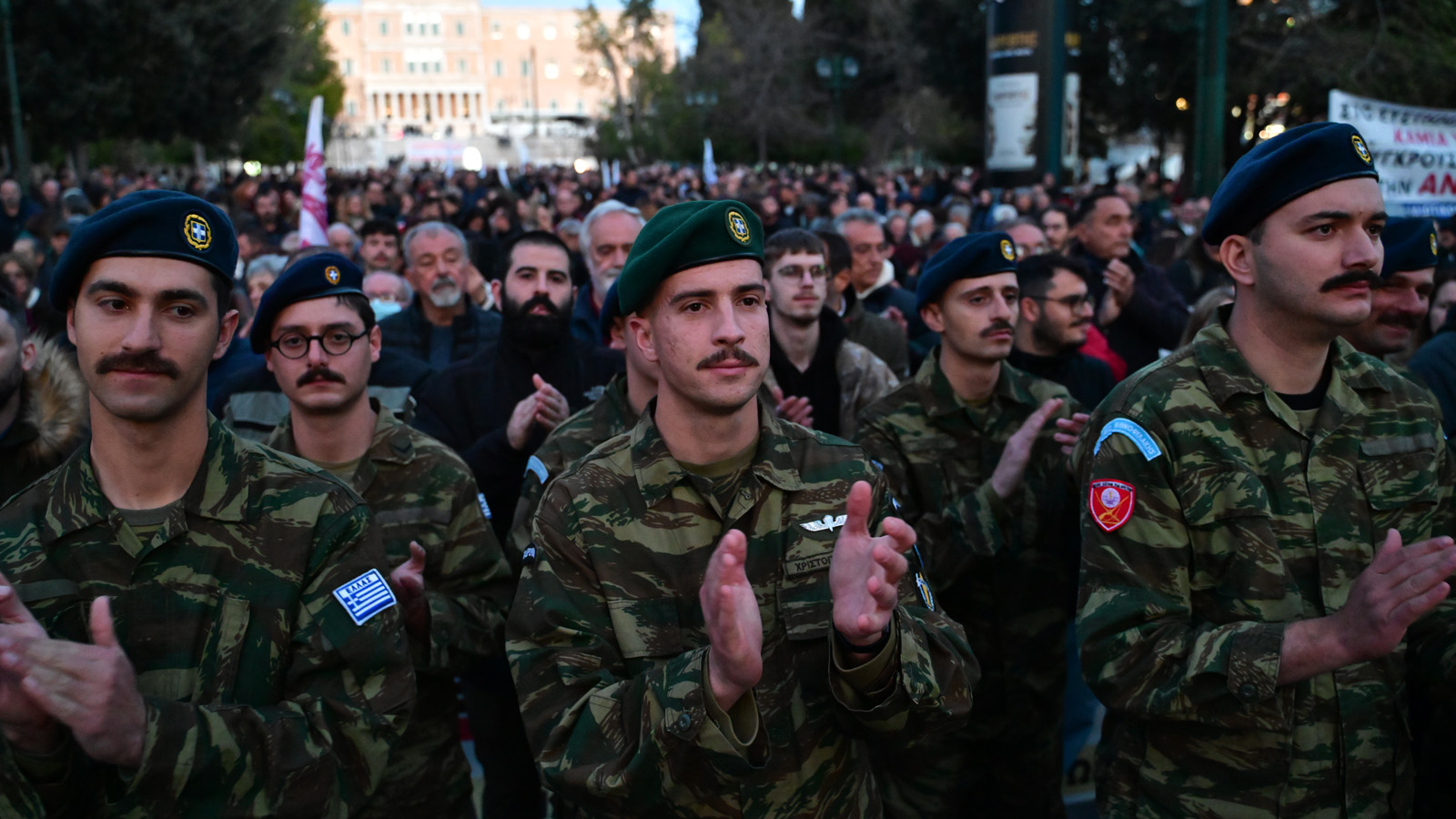
It should be noted that the authorities are attempting, through disciplinary penalties imposed on conscripts, to keep them away from the country’s social and political life. This punitive approach has met resistance from trade unions, university student unions, and, of course, the KKE. In recent days, the formation of conscripts’ committees in Greece has caused a stir both domestically and internationally.
Rizospastis —the organ of the Central Committee of the KKE— published on 29 March an interview with two soldiers: Orpheas Drakoulis, an infantryman at the Special Forces Training Centre, and Kyriakos Paraskevopoulos, an infantry soldier in ELDYK (note: Greek Force in Cyprus, the Greek Army regiment permanently stationed there). They described their experience of this initiative, which has been embraced by many of their fellow conscripts. We present this interview below:
What led you to decide to form the conscripts’ committees?
O. D.: The Conscripts’ Committee at the Special Forces Training Centre arose from the need to request official briefings from the command regarding developments related to the war and the involvement of the country and the Armed Forces. Most of us had studied in university, had jobs before joining the military, and had lived our lives responsibly and with dignity.
When we reported for duty, we heard things we had never encountered in the media, while the command fostered a sense of complacency that bore no relation to reality. From the government’s initial claim that “we have no involvement in the wars”, followed by the “trigger that was pulled” with the deployment of a Greek Patriot battery sent by the government to guard the “Aramco” refineries in the Kingdom of Saudi Arabia, we moved to the narrative that “we are getting involved in the war for the national interest of the country, and that this is a move that protects us against rising prices and inflation”. Through our discussions within the camp, we realized day by day that the situation is serious; the arguments we are hearing are dangerous for our people, and we cannot simply stand by and watch developments unfold.
K. P.: After Iran’s retaliation against the British base in Cyprus and the downing of drones in Akrotiri, concern among ELDYK soldiers was considerable. Our families and friends asked us daily what was happening and we had no official information. We learned about the escalation of the war and the Greek government’s decisions to take a leading role by actively participating in it from the news.
While commanders foster complacency, our involvement in the war alongside NATO, the EU, and the US is deepening —all in the interests of a handful of plunderers who profit from the devastation of war, while serious dangers loom over the people of Greece and Cyprus. For this reason, many soldiers initially wrote letters condemning participation in the war, and later went on to form a committee, drawing courage from our fellow conscripts in Greece.
The consequences of the government’s involvement in the war are already weighing heavily on us. Even during leave, at a time when the Greek government is spending billions of euros on NATO equipment and participation in NATO and EU missions, such as those currently underway in the wider region, we soldiers are forced to pay out of our own pockets for a ticket costing over 250 euros to return to Greece to see our families during the Easter leave, and just as much again to go back! Even the higher pay we received compared to Greece is not enough to cover these travel costs.
If the government truly wished to protect the people from the high cost of living, it would provide free travel to all conscripts throughout their service. It would not send artillery units to Saudi Arabia to defend “Aramco” in a war that serves interests other than our own —a factor that, in the end, means the Greek people and the soldiers are the ones paying the price through rising costs.
How was this idea received in your camps?
O. D.: The Committee was very quickly embraced by the vast majority of conscripts. Those who agreed, and even more who recognized its necessity, came up to us to say “well done” and that “thanks to you, our voice has been heard”.
Despite initial concerns and some attempts at intimidation, our discussions made it clear that, under these conditions of military service, we need even greater solidarity and mutual support, first and foremost in dealing with the consequences of the war, such as high prices and cuts to basic provisions within the camps. Within a short time, we realized that what we, as conscripts from two barracks, had first identified, was shared by many others. Increasingly, conscripts were saying that the country and the Armed Forces must cease participation in foreign wars; that the people have nothing to gain from this involvement; that NATO and US bases should close; and that all Armed Forces, including the F-16s, the frigates, and the Patriot batteries deployed abroad, should return home.
The importance of the Committee, which made it known to even more conscripts, was further highlighted by the situation in the camp infirmary. From the second week of enlistment, cases of gastroenteritis, colds and infections emerged, due to poor hygiene, unsanitary conditions, overcrowding in barracks and mess halls, and insufficient medical staff in the military health services.
Following our swearing-in ceremony, we intend to form committees from the very first day in the units to which we are assigned.
K.P.: Many of us across different camps discussed these issues and recognized the need to defend ourselves against war and austerity. The formation of the Committee at the Special Forces Training Centre and elsewhere gave us courage. There is widespread support, as there was a clear need to establish the ELDYK Committee. In my view, every conscript serving in ELDYK should get in touch with the Committee!
We demand:
- Daily updates on developments in the Middle East and the wars.
- The closure of military bases in Greece and Cyprus.
- Full state coverage of travel expenses during leave.
- Immediate provision of adequate hot water and heating in the barracks.